Rules updated June 2026 9 routes supported Free — no sign-up Solicitor-reviewed content Last reviewed: 5 June 2026
Updated for the 2026 Home Office Rules

ILR Calculator UK — Free Indefinite Leave to Remain Check

Find out exactly when you can apply for Indefinite Leave to Remain. The calculator applies the Home Office continuous residence rules, the 28-day early application window and route-specific absence limits — instantly, in your browser, with no sign-up.

180
Max days absence per year
28
Days early you can apply
£3,226 UPDATED
Current ILR fee (April 2026)
9
Visa routes supported
Solicitor-reviewed content Nothing stored — runs in your browser Instant results

6 Precision Tools

Eligibility, dates, absences, continuous residence and qualifying period — all in one place.

Home Office Aligned

Appendix Settlement, FM, Continuous Residence, Global Talent and paragraph 276B — June 2026.

Instant Results

No sign-up, no data stored on any server, no email required. Runs entirely in your browser.

Solicitor-Reviewed

All content reviewed by qualified UK immigration lawyers regulated by the SRA and OISC.

Earned Settlement 2026 — What You Need to Know Right Now

The UK Government proposed an Earned Settlement reform that would extend the ILR qualifying period from 5 years to 10 years for most routes. As of June 2026, no new Immigration Rules have been laid — the 5-year route remains fully operative. The Home Affairs Committee (HC 1409, March 2026) endorsed the 10-year baseline but urged grandfathering for those mid-route; the government has not yet responded. Implementation is expected no earlier than Autumn 2026 and may slip to early 2027.

If you qualify under current rules, applying now protects your position. Transitional arrangements remain unconfirmed, and a B2 English requirement takes effect regardless from 26 March 2027. Check how the reform affects your timeline →

B2 English from 26 March 2027 (already in law): Under HC 1691 (March 2026 Statement of Changes), the English language requirement for most ILR routes rises from B1 to B2. This is independent of Earned Settlement. If your application falls after this date, start preparing your B2 evidence now.

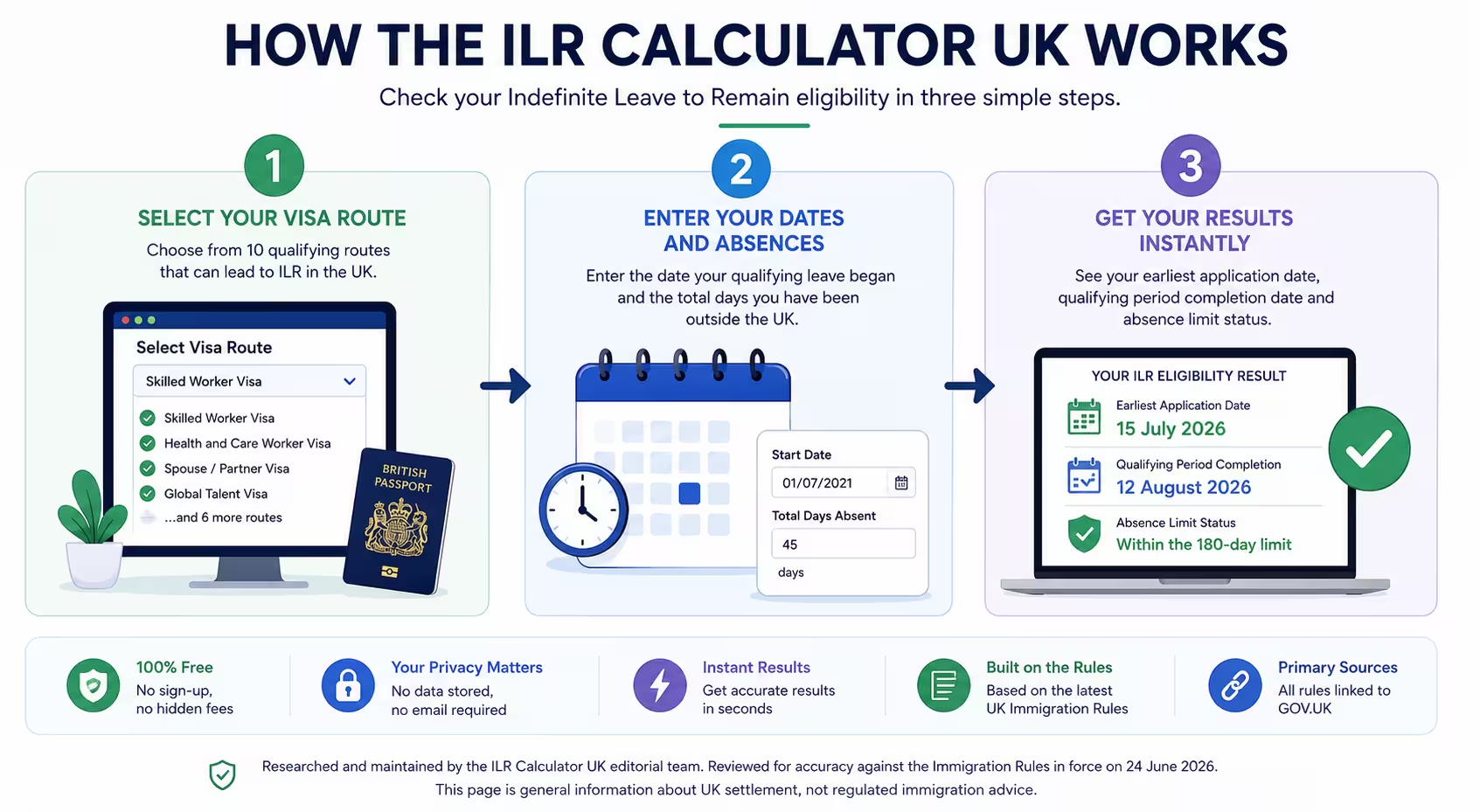
How the ILR Calculator UK Works

Check your Indefinite Leave to Remain eligibility in three simple steps.

1

Select your visa route

Choose from nine qualifying routes — Skilled Worker, Health and Care Worker, Spouse/Partner, Global Talent, Innovator Founder, Investor, UK Ancestry or 10-year Long Residence.

2

Enter your dates and absences

Input the date your qualifying leave began and your total days spent outside the UK during the qualifying period.

3

Get your results instantly

See your earliest application date, qualifying period completion date, and whether your absences meet the route-specific limits under the current 2026 Immigration Rules.

Free Tool

Check Your UK ILR Eligibility Instantly

Enter your visa route, start date and absences to find out exactly when you can apply for Indefinite Leave to Remain — including your earliest valid application date under the Home Office 28-day window rule at paragraph CR 1.2(a).

Select the visa route you were granted when you first entered the UK for this qualifying period. If you switched routes, use the route you are currently on — switching may affect your start date.
Please select an immigration route
This is the date your first grant of qualifying leave began. If you physically arrived in the UK more than 180 days after this date, your qualifying period may start from your arrival date instead.
Please enter a valid date
Enter your total days absent. The Home Office checks this in rolling 12-month periods. If unsure of your exact total, use our Absence Calculator first.
Please enter a whole number (0 or more)

Also Known As: Permanent Residence, Settlement and Settled Status

People search for this status under many names — permanent residence, PR, UK settlement, settled status — but the legal term is Indefinite Leave to Remain. Whatever you call it, the test is the same: a qualifying period of lawful residence assessed against Appendix Continuous Residence and the absence limits for your route. The tools on this site check that test for the 5-year Skilled Worker route, the Spouse visa, the 10-year Long Residence path and six other routes, and tell you the earliest date you can validly apply — the first concrete step towards British citizenship.

Earned Settlement 2026 — How It Affects Your ILR Timeline

The UK Government’s Earned Settlement proposal (May 2025 Immigration White Paper) would replace the standard 5-year route with a 10-year qualifying period for most routes, with a 15-year period for those deemed lower-skilled. As of June 2026, no Statement of Changes implementing these rules has been laid before Parliament. The 5-year route remains fully operative.

The Home Affairs Committee published its report (HC 1409, 20 March 2026) endorsing the 10-year baseline but recommending grandfathering for applicants already mid-route. The government was required to respond by 13 May 2026 but has not done so. A judicial review by the Skill Migrants Alliance (representing approximately 1.6 million workers) is being prepared. Implementation is currently expected no earlier than Autumn 2026, with legal experts suggesting early 2027 is more realistic.

Action required if you are near the 5-year mark: If you qualify under current rules — or will qualify within the next 6–12 months — applying now under the existing 5-year framework is the safest option. There is no confirmed grandfathering guarantee, and transitional arrangements remain undefined. The eligibility calculator will show your qualifying date instantly.

Critical Checks Before You Calculate

Working out your settlement date is not always as simple as counting 5 years on a calendar. The Home Office applies specific rules that can alter your qualifying period start date. Review these two scenarios first:

  • Delayed Entry (the 180-day rule): If you were granted a visa but physically entered the UK more than 180 days later, your qualifying period starts from the date you physically arrived, not the date on your visa.
  • Switching visa routes: If you switch from a work visa (e.g. Skilled Worker) to a family visa (e.g. Spouse), be careful. Time spent on a Skilled Worker visa usually does not count towards the Spouse route. Switching can “reset the clock” to zero unless the routes are compatible.
Important: If you have switched visa types or have gaps in your leave, use the detailed Continuous Residence Calculator or consult a solicitor — the tool above assumes a straightforward qualifying period.

What Is Indefinite Leave to Remain (ILR)?

Indefinite Leave to Remain — also known as UK settlement, permanent residence or settled status — is the immigration status that frees you from time-limited visas. Once granted by UK Visas and Immigration (UKVI), it allows you to live, work, study and access public funds in the United Kingdom without restriction. It is the final step before applying for British citizenship by naturalisation under the British Nationality Act 1981.

How Long Does ILR Take to Qualify?

The qualifying period depends on your visa category. Skilled Worker, Health and Care Worker, Spouse, Partner, UK Ancestry, Global Talent and most family routes lead to settlement after a continuous 5-year qualifying period. Long Residence applicants qualify after 10 years of continuous lawful residence, while certain accelerated routes such as the Innovator Founder visa or the Tier 1 Investor visa (under transitional arrangements) can deliver settlement in 3 years.

How the ILR Calculator UK Computes Your Settlement Dates

Each tool on this site is built around the Immigration Rules published by the UK Home Office and refined by experienced immigration solicitors regulated by the SRA and OISC. Whether you need to confirm your eligibility, find your earliest application date, check the 28-day early-application window, track your days absent from the UK, review continuous residence, or measure your qualifying period, you get a fast, free, mobile-friendly answer. Every tool runs entirely in your browser — no data is stored on any server.

Which UK Visas Lead to ILR?

The most common settlement routes are the Skilled Worker visa (formerly Tier 2 General), the Health and Care Worker visa, the Spouse or Partner visa under Appendix FM, the UK Ancestry visa, the Global Talent visa, the Innovator Founder visa and the 10-year Long Residence route under paragraph 276B of the Immigration Rules. Refugees and individuals with humanitarian protection also qualify after 5 years. The eligibility tool supports all of these categories and assesses both your qualifying period and your absences in a single workflow.

Qualifying Periods and Absence Limits by Visa Route

Different visa routes lead to settlement under different sections of the Immigration Rules, and each carries its own qualifying period, absence allowance and continuous residence test. The table below shows how these differ across the main routes.

Source: UK Home Office Immigration Rules — Appendix Settlement, Appendix FM, Paragraph 276B. Updated June 2026.
Visa RouteQualifying PeriodTotal Absence LimitPer 12-Month LimitSingle Trip LimitRule ReferenceCalculator
Skilled Worker5 yearsNo fixed limit180 daysAppendix SettlementCheck now →
Health and Care Worker5 yearsNo fixed limit180 daysAppendix SettlementCheck now →
Spouse / Partner (Appendix FM)5 yearsNo fixed limit180 daysAppendix FMCheck now →
UK Ancestry5 years540 days180 daysAppendix SettlementCheck now →
Global Talent (3-year)3 yearsNo fixed limit180 daysAppendix Global TalentCheck now →
Global Talent (5-year)5 years540 days180 daysAppendix Global TalentCheck now →
Innovator Founder3 yearsNo fixed limit180 daysAppendix Innovator FounderCheck now →
Investor (Transitional)5 years540 days180 daysTransitional provisionsCheck now →
10-Year Long Residence10 years540 days180 days184 daysParagraph 276BCheck now →
Key distinction: Routes marked “No fixed total absence limit” (Skilled Worker, Spouse, Global Talent 3-year, Innovator Founder) are assessed purely on the 180-day rolling 12-month rule — there is no ceiling on cumulative days. Routes with a 540-day total limit apply both checks. The 10-year Long Residence route is the only one with a single-trip cap of 184 days.

Continuous Residence Requirements

To qualify for Indefinite Leave to Remain, most applicants must demonstrate a specific period of lawful residence, typically 5 or 10 years. Continuous residence sits at the heart of every application. UKVI requires that, throughout your qualifying period, you held lawful immigration status without any unauthorised gaps. Even short overstays — a single day between visa expiry and the grant of new leave — can break continuity unless one of the limited paragraph 39E exceptions applies (overstays of 14 days or less where the applicant had reasons beyond their control). The continuous residence tool helps you confirm that your timeline is unbroken and identifies the precise dates that make up your qualifying period.

Visa changes do not break continuity in most cases. Switching from Tier 2 to Skilled Worker, or from Student to Spouse, does not reset the clock — provided there was no gap between the expiry of one grant and the start of the next. Time spent on predecessor visas (Tier 2 General, Tier 1, PBS dependant) counts towards the qualifying period for the corresponding modern route.

The 180-Day Absence Rule

You must not have spent more than 180 days outside the UK in any 12-month rolling period. The Home Office checks rolling windows, not calendar years — so a 12-month window can start on any date in your travel history.

UKVI counts part-days as full days for absence purposes — a departure at 23:59 and return at 00:01 the following day counts as two days absent. The absence tool models this rolling rule trip-by-trip so that you can spot risk before you submit.

For Long Residence applicants under paragraph 276B, the test is different: a maximum of 540 days across the entire 10-year period and no single absence over 184 days. Any single trip exceeding 184 days is likely to break continuous residence unless there were compelling or compassionate circumstances — such as serious illness, a family emergency, or a natural disaster.

The 28-Day Early Application Window

Under paragraph CR 1.2(a) of Appendix Continuous Residence, you can submit your application up to 28 calendar days before your qualifying period completes. This includes weekends and bank holidays. The window protects against gaps in lawful status while UKVI processes your application and triggers section 3C leave under the Immigration Act 1971, which extends your lawful status while a decision is pending.

Warning: Apply 29 or more days early and your application will be refused as premature. You will lose the £3,226 application fee with no refund and must wait to re-apply within the correct window. Use the 28 days tool to find the exact earliest valid submission date.

Other ILR Requirements You Must Meet

The time-based rules covered by these calculators are necessary but not sufficient. Applicants aged 18 to 64 must also satisfy the requirements below. Failure on any of these will lead to refusal regardless of your qualifying period and absences.

Life in the UK Test

Must be passed within 2 years before applying. The certificate is valid indefinitely once obtained. Covers British history, values, traditions and everyday life.

English Language — B1 now, B2 from March 2027

CEFR B1 currently required. Rises to B2 from 26 March 2027 (HC 1691). Exempt if you hold a qualifying English-taught degree, are a national of a majority English-speaking country, or are aged 65+.

Suitability (Part 9)

No serious criminal convictions, use of deception in an application, NHS debt exceeding £500, or serious breaches of immigration law. From 8 April 2026, a suspended sentence of 12+ months also triggers mandatory refusal.

Financial Requirement (Spouse/FM routes)

Minimum income of £29,000 from April 2025, rising to £34,500 in late 2026 and £38,700 in 2027. Savings or combined income with a sponsor may be used.

Route-Specific Criteria

Sponsorship continuity for work routes, genuine and subsisting relationship for spouse routes, endorsement milestones for Global Talent and Innovator Founder, Commonwealth citizenship for Ancestry.

Application Fees and Processing Times (2026)

The standard Home Office fee for a settlement application rose to £3,226 per applicant on 8 April 2026 — a 6.5% increase from the previous £3,029. The Immigration Health Surcharge for settlement applications remains £0. All fees are non-refundable if the application is refused.

Priority Processing Options (2026)

Optional priority services are available for in-country applications: the decision-ready service costs £3,726 (targets a decision within 5 working days) and the super-priority service costs £4,226 (aims for the next working day). Standard processing takes up to six months but most straightforward decisions are issued within eight weeks. Biometric enrolment at a UKVCAS centre is mandatory for all in-country applications. All applications must be submitted online via GOV.UK — paper form SET(O) is no longer accepted.

From ILR to British Citizenship

Once you hold Indefinite Leave to Remain you may apply for British citizenship by naturalisation after a further 12 months of residence — or immediately if you are married to or in a civil partnership with a British citizen. Settlement also supports applications for a British passport for any children born or registered in the UK while you are settled.

ILR is not the same as citizenship. You remain a foreign national with settled status. You can lose it if you leave the UK for more than 2 consecutive years, unless you have applied for and been granted a Returning Resident visa before the 2-year threshold expires.

Why Use ILR Calculator UK?

Each tool is purpose-built around a single decision point in the settlement journey, then connected to the others so you can move from “Am I eligible?” to “When can I apply?” to “Have I had too many absences?” without leaving the site. We update every tool within days of any Statement of Changes to the Immigration Rules.

Built on the Actual Immigration Rules Appendix Text

We also explain the procedural details that decide real cases: how UKVI counts part-days for absences, how the 28-day early application window interacts with biometric appointments, when paragraph 39E exceptions for overstayers apply, how the continuous residence clock pauses (or breaks) on visa changes, and what to do if you have switched between routes. That depth of coverage — grounded in the actual Appendix text, not summaries — is what turns a simple date checker into a genuine settlement planning tool.

Your data stays in your browser. Every tool on this site runs entirely client-side. We do not store your dates, visa history or travel records on any server. There is no sign-up wall, no email gate and no charge — just instant answers.

Regulated UK Immigration Solicitors

Need certainty on your eligibility?

The calculator gives you a clear estimate, but every Indefinite Leave to Remain case is unique. Book a confidential consultation with an experienced UK immigration solicitor today.

Speak to a Solicitor No obligation · Confidential · UK-qualified

Frequently Asked Questions

What is the ILR calculator UK and how does it work?
An ILR calculator UK is a free online tool that checks whether you meet the time-based requirements for Indefinite Leave to Remain. You select your visa route, enter the date your qualifying leave began and your total days absent from the UK. The tool then calculates your qualifying period completion date, earliest application date under the 28-day concession at CR 1.2(a), and whether your absences are within the permitted limits for your route.
How do I calculate my ILR eligibility?
Use the tool above: select your visa route (e.g. Skilled Worker, Spouse, Long Residence), enter the date your qualifying leave began and your total days absent. It checks your qualifying period, the 28-day early window and absence limits automatically. For a more precise check, use the trip-by-trip absence calculator.
What is the 180-day absence rule for ILR?
You must not have been outside the UK for more than 180 days in any rolling 12-month period within your qualifying period. The Home Office checks rolling windows — not calendar years — so a 12-month window can start on any date. Exceeding 180 days in even one period can lead to refusal unless exceptional circumstances apply.
How many years do I need for ILR in the UK?
Most routes require 5 years (Skilled Worker, Health and Care Worker, Spouse, Ancestry). Some allow 3 years (Global Talent accelerated, Innovator Founder). The 10-year Long Residence route under paragraph 276B requires 10 years in any combination of qualifying categories.
Can I apply for ILR 28 days early?
Yes. Under paragraph CR 1.2(a) of Appendix Continuous Residence, you can submit up to 28 calendar days before your qualifying period completes. This includes weekends and bank holidays. Applying 29+ days early results in refusal and you lose the £3,226 fee.
What is the ILR application fee in 2026?
The application fee rose to £3,226 per applicant on 8 April 2026 — a 6.5% increase. The super-priority service costs £4,226 and the decision-ready service costs £3,726. The Immigration Health Surcharge for settlement is £0. All fees are non-refundable if the application is refused.
What is Earned Settlement and does it affect me?
The UK Government proposed an Earned Settlement reform that would extend the qualifying period from 5 years to 10 years for most routes. As of June 2026, no new Immigration Rules have been laid — the 5-year route is still fully in force. Implementation is expected no earlier than Autumn 2026 and may slip to early 2027. If you qualify under current rules, applying now is the safest option as transitional protections remain unconfirmed.
Will the English language requirement change for ILR in 2027?
Yes. Under HC 1691 (March 2026 Statement of Changes), the English language requirement for most routes rises from CEFR B1 to B2 from 26 March 2027. This is already law and applies regardless of the Earned Settlement outcome. If your application date falls after 26 March 2027, you will need a B2-level English test certificate.
Does the calculator guarantee approval?
No. It checks time-based requirements only. Other mandatory requirements include: Life in the UK Test, English language at CEFR B1 (B2 from March 2027), suitability under Part 9 of the Immigration Rules, and route-specific criteria such as the financial requirement for spouse routes and sponsorship continuity for work routes.
Can I get ILR after 10 years in the UK?
Yes. Under paragraph 276B, anyone with 10 years of continuous lawful residence in any combination of qualifying visa categories can apply. The limits are 540 days total and no single trip exceeding 184 days. Use the eligibility tool to check your position.
Which visa routes does the calculator support?
Nine routes: Skilled Worker, Health and Care Worker, Spouse/Partner (Appendix FM), Global Talent (3-year and 5-year), Innovator Founder, Investor (transitional), UK Ancestry and 10-year Long Residence. Each route has its own qualifying period and absence limits configured according to the relevant Appendix.
What other requirements must I meet for ILR?
Life in the UK Test (passed within 2 years before applying), English language at CEFR B1 (rising to B2 from 26 March 2027), suitability under Part 9 of the Immigration Rules (no serious convictions, deception or NHS debt over £500), and for spouse routes, the financial requirement (minimum £29,000 from April 2025, rising to £34,500 in late 2026).
Can ILR lead to British citizenship?
Yes. After holding ILR for 12 months you can apply for British citizenship by naturalisation — or immediately if married to a British citizen. ILR is the standard gateway to citizenship for migrants.
Is this calculator accurate for the 2026 Immigration Rules?
Yes. It reflects the current Immigration Rules as consolidated in Appendix Settlement, Appendix FM, Appendix Continuous Residence, Appendix Global Talent, Appendix Innovator Founder and paragraph 276B. Route-specific absence limits, qualifying periods and the 28-day concession at CR 1.2(a) are correctly configured. Fees reflect the April 2026 increase to £3,226. Last reviewed June 2026.